
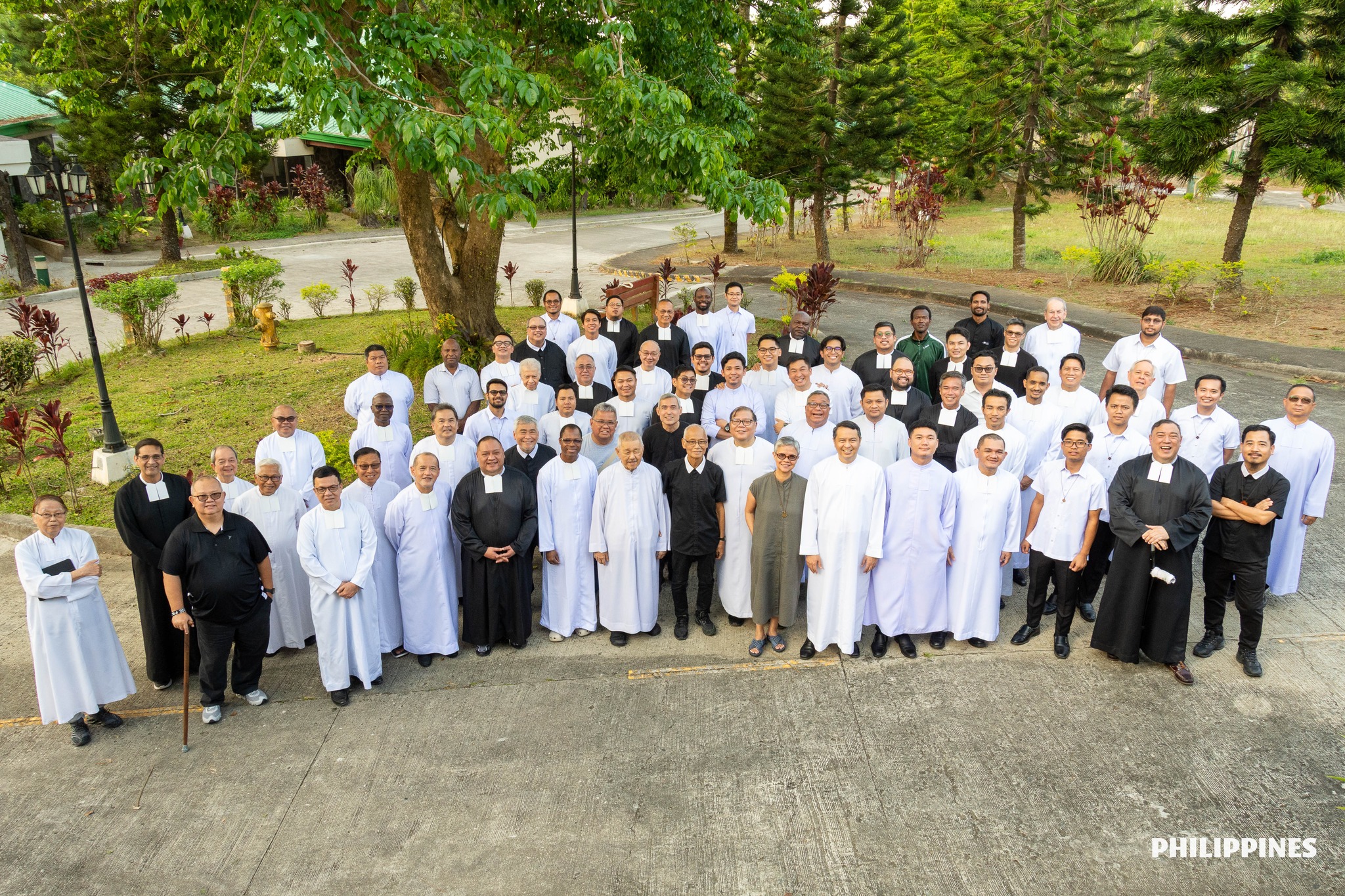
In the stillness of Holy Week, when the Church enters into the deepest mysteries of Christ’s passion, death, and resurrection, Brothers from the Lasallian East Asia District gathered in Tagaytay from 01-04 April 2026, for a retreat that invited not only remembrance, but transformation. Guided by Sr. Bubbles Bandojo, RC, the retreat unfolded as a deliberate journey into the heart of fraternity, framed not as a static identity, but as an ongoing, intentional practice: brothering.
The opening day of the retreat grounded the Brothers in a simple yet demanding truth: community does not arise automatically from proximity. Living under one roof does not guarantee communion. Instead, fraternity must be built, intentionally, patiently, and concretely, through acts of presence and encounter.
Sr. Bubbles introduced the central lens of the retreat through the notion of brothering. To “brother” is to act, to choose, to engage. It is the ongoing decision to be present to the other, not only physically, but emotionally and spiritually. In this sense, presence becomes more than availability; it becomes sacramental, a visible sign of God’s love mediated through human relationships.
This practice of brothering was explored through four interrelated dimensions. Hospitality calls for the creation of spaces where others can exist freely and safely, resisting exclusion and affirming dignity. Vulnerability invites the courage to be seen as one truly is, recognizing that authentic relationships are not built on perfection but on truth. Solidarity moves beyond sympathy into shared life, a willingness to stand with others in their struggles. And compassion grounds all of these in a love that is attentive and responsive.
These movements are not abstract virtues but concrete practices. The Emmaus Walk, faith-sharing sessions, and moments of personal reflection reinforced this call to encounter, particularly with those who remain unfamiliar even within one’s own community. In these small but intentional gestures, fraternity begins to take shape.
The retreat’s reflection deepened on Holy Thursday, shifting from encounter to communion. Drawing from the Gospel of the washing of the feet, Sr. Bubbles invited the Brothers to reconsider the meaning of authority and leadership within community life. In kneeling before His disciples, Jesus redefines greatness, not as power or status, but as humble service rooted in love.
This reorientation finds its deepest grounding in the mystery of the Trinity. God, in His very being, is relational, Father, Son, and Spirit in a constant exchange of love. Community, therefore, is not merely organizational; it is participatory. To live in fraternity is to share, however imperfectly, in this divine relationality.
Within the Lasallian tradition, this takes concrete form in the call to live “together and by association.” Association extends beyond shared residence; it is a commitment to a common mission. It calls the Brothers to act not as isolated individuals, but as a collective body responding to the needs of the world. Yet the retreat did not romanticize this vision. It acknowledged the tensions inherent in community life, differences in personality, approaches to conflict, and expectations. These are not signs of failure, but opportunities for growth. Communion is forged not in the absence of tension, but in the willingness to remain, to dialogue, and to choose unity despite difference.
If the first two days established the foundations of encounter and communion, the third day moved into more demanding terrain: vulnerability and forgiveness. Here, the retreat confronted one of the greatest barriers to authentic fraternity, the fear of being truly known.
In many contexts, vulnerability is perceived as weakness, particularly within leadership. Yet Sr. Bubbles reframed it as a profound expression of courage. To be vulnerable is to stand without defenses, to risk rejection, and to offer oneself without guarantees. It is, ultimately, to love in the way Christ loved.
The cross becomes the definitive image of this vulnerability. In His suffering, Jesus reveals that love is not about invulnerability, but about self-gift, even in the face of pain and uncertainty. This redefinition has significant implications for leadership within the community. Authentic leadership does not demand perfection; it invites honesty. It creates space for others to contribute, to speak, and to be.
However, vulnerability cannot exist in isolation. It requires a community that is capable of receiving it. Without an environment of trust and acceptance, vulnerability becomes too costly, and relationships remain superficial.
The retreat therefore emphasized the importance of emotional presence, the capacity to accompany rather than to fix, to listen rather than to resolve. In choosing to remain with another in their vulnerability, fraternity deepens.
The “Way of Vulnerability,” inspired by the Stations of the Cross, offered a path through which the Brothers could reflect on their own experiences of failure, dependence, and surrender. It is in these spaces, often uncomfortable and uncertain, that genuine communion is forged.
The final day of the retreat, set within the quiet of Holy Saturday, marked a profound shift. After days of reflection and engagement, the Brothers were invited into stillness, a space where no immediate answers are required, and where transformation unfolds beneath the surface.
Sr. Bubbles described Holy Saturday as a threshold moment, a space between death and resurrection. It is a time marked by absence, uncertainty, and waiting. Yet it is precisely in this silence that deeper integration occurs.
At the heart of this reflection is the image of Christ descending into the depths of death. This descent is not symbolic; it is the fullest expression of solidarity. Jesus does not remain distant from human suffering, He enters into it completely, even into its most desolate dimensions.
This movement reveals the true nature of compassion. It is not mere sympathy, but a willingness to be with, to stand alongside, to share in the experience of the other. Compassion and solidarity are inseparable; one cannot exist without the other.
Within the Lasallian mission, this solidarity calls for what Sr. Bubbles described as “prophetic audacity”, the courage to move beyond comfort, to engage with the margins, and to respond to the needs of the world with authenticity. It is a reminder that the mission is not about saving others from a distance, but about entering into relationships that transform all involved.
Central to this is the recognition of radical kinship: that we belong to one another. The divisions between “us” and “them” begin to dissolve, revealing a deeper unity grounded in shared humanity. In this light, the greatest obstacle to compassion is not hatred, but indifference, a quiet withdrawal from the responsibility to respond.
Holy Saturday, then, becomes not an empty pause, but a necessary space of reorientation. It prepares the heart to act, not out of impulse, but out of depth.
At the core of the retreat’s reflections lies a unifying insight: fraternity is not merely about relationships among Brothers; it is an expression of love for God and for all His creation.
To live in fraternity is to participate in the very life of God, whose being is relational. Every act of hospitality, every moment of presence, every gesture of compassion becomes a concrete expression of this love. In loving one another, the Brothers do not simply fulfill a communal obligation, they reveal something of God’s own nature.
This love, however, cannot remain confined within the community. It necessarily extends outward. The same fraternity that binds the Brothers together calls them into deeper solidarity with others, particularly those who are marginalized or excluded. In this way, fraternity becomes both contemplative and active, rooted in God and directed toward the world.
It is here that the retreat’s theme of brothering finds its fullest meaning. To brother is to love as God loves, freely, vulnerably, and without exclusion. It is to recognize that every encounter is an opportunity to make visible the presence of God.
Toward Easter: A Fraternity Renewed
As the retreat drew to a close, the Brothers stood at the threshold of Easter, not merely as observers of the Resurrection, but as participants in its unfolding. The journey through presence, communion, vulnerability, and solidarity had prepared them to receive the promise of new life with greater depth and clarity.
The invitation moving forward is both simple and demanding: to continue the practice of brothering in the ordinary rhythms of daily life. Fraternity is not built in extraordinary moments alone, but in the quiet, consistent choices to be present, to listen, to serve, and to love.
In a world often marked by fragmentation and isolation, the witness of authentic fraternity becomes all the more urgent. It is a reminder that communion is possible, that relationships can be transformative, and that in choosing to belong to one another, we participate in the very life of God.
As Easter dawns, the call remains, to live as brothers, not only in name, but in action.


